
helicity
helicity#
import ampform.helicity
Generate an amplitude model with the helicity formalism.
- class HelicityModel(intensity: PoolSum, amplitudes: Mapping[Indexed, Expr], parameter_defaults: Mapping[Basic, ParameterValue], kinematic_variables: Mapping[Symbol, Expr], components: Mapping[str, Expr], reaction_info: ReactionInfo)[source]#
Bases:
object- intensity: PoolSum#
Main expression describing the intensity over
kinematic_variables.
- amplitudes: OrderedDict[Indexed, Expr]#
Definitions for the amplitudes that appear in
intensity.The main
intensityis a sum over amplitudes for each initial and final state helicity combination. These amplitudes are indicated with assp.Indexedinstances and this attribute provides the definitions for each of these. See also TR-014.
- parameter_defaults: ParameterValues#
A mapping of suggested parameter values.
Keys are
Basicinstances from the mainexpressionthat should be interpreted as parameters (as opposed tokinematic_variables). The symbols are ordered alphabetically by name with natural sort order (natural_sorting()). Values have been extracted from the inputReactionInfo.
- kinematic_variables: OrderedDict[Symbol, Expr]#
Expressions for converting four-momenta to kinematic variables.
- components: OrderedDict[str, Expr]#
A mapping for identifying main components in the
expression.Keys are the component names (
str), formatted as LaTeX, and values are sub-expressions in the mainexpression. The mapping is anOrderedDictthat orders the component names alphabetically with natural sort order (natural_sorting()).
- reaction_info: ReactionInfo#
- property expression: Expr#
Expression for the
intensitywith all amplitudes fully expressed.Constructed from
intensityby substituting its amplitude symbols with the definitions withamplitudes.
- rename_symbols(renames: Iterable[tuple[str, str]] | Mapping[str, str]) HelicityModel[source]#
Rename certain symbols in the model.
Renames all
Symbolinstance that appear inexpression,parameter_defaults,components, andkinematic_variables. This method can be used to couple parameters.- Parameters
renames – A mapping from old to new names.
- Returns
A new instance of a
HelicityModelwith symbols in all attributes renamed accordingly.
- class ParameterValues(parameters: Mapping[Basic, Union[float, complex, int]])[source]#
Bases:
MappingOrdered mapping to
ParameterValuewith convenient getter and setter.This class makes it possible to search through a mapping of
sympysymbols to their values (a “parameter mapping”) by symbol name or by index in the (ordered) dictionary.>>> a, b, c = sp.symbols("a b c") >>> parameters = ParameterValues({a: 0.0, b: 1+1j, c: -2}) >>> parameters[a] 0.0 >>> parameters["b"] (1+1j) >>> parameters["b"] = 3 >>> parameters[1] 3 >>> parameters[2] -2 >>> parameters[2] = 3.14 >>> parameters[c] 3.14
- class DynamicsSelector(transitions: ReactionInfo | Iterable[StateTransition])[source]#
Bases:
MappingConfigure which
ResonanceDynamicsBuilderto use for each node.- assign(selection, builder: ResonanceDynamicsBuilder) None[source]#
Assign a
ResonanceDynamicsBuilderto a selection of nodes.Currently, the following types of selections are implements:
str: Select transition nodes by the name of theparentParticle.TwoBodyDecayortupleof aStateTransitionwith a node ID: set dynamics for one specific transition node.
- class HelicityAmplitudeBuilder(reaction: ReactionInfo, stable_final_state_ids: Iterable[int] | None = None, scalar_initial_state_mass: bool = False)[source]#
Bases:
objectAmplitude model generator for the helicity formalism.
- Parameters
reaction – The
ReactionInfofrom which toformulate()an amplitude model.stable_final_state_ids – Put final state ‘invariant’ masses (\(m_0, m_1, \dots\)) under
HelicityModel.parameter_defaults(with a scalar suggested value) instead ofkinematic_variables(which are expressions to compute an event-wise array of invariant masses). This is useful if final state particles are stable.stable_final_state_ids –
Put the invariant of the initial state (\(m_{012\dots}\)) under
HelicityModel.parameter_defaults(with a scalar suggested value) instead ofkinematic_variables. This is useful if four-momenta were generated with or kinematically fit to a specific initial state energy.See also
- naming: NameGenerator#
Name generator for amplitude names and coefficient names.
See also
- align_spin: bool#
(De)activate spin alignment.
- use_helicity_couplings: bool#
Use helicity couplings instead of amplitude coefficients.
Helicity couplings are a measure for the strength of each partial two-body decay. Amplitude coefficients are the product of those couplings.
- property adapter: HelicityAdapter#
Converter for computing kinematic variables from four-momenta.
- property dynamics_choices: DynamicsSelector#
- property stable_final_state_ids: set[int] | None#
IDs of the final states that should be considered stable.
The ‘invariant’ mass symbols for these final states will be inserted as scalar values into the
parameter_defaults.
- property scalar_initial_state_mass: bool#
Add initial state mass as scalar value to
parameter_defaults.See also
- set_dynamics(particle_name: str, dynamics_builder: ResonanceDynamicsBuilder) None[source]#
- formulate() HelicityModel[source]#
- class CanonicalAmplitudeBuilder(reaction: ReactionInfo)[source]#
Bases:
HelicityAmplitudeBuilderAmplitude model generator for the canonical helicity formalism.
This class defines a full amplitude in the canonical formalism, using the helicity formalism as a foundation. The key here is that we take the full helicity intensity as a template, and just exchange the helicity amplitudes \(F\) as a sum of canonical amplitudes \(A\):
\[F^J_{\lambda_1,\lambda_2} = \sum_{LS} \mathrm{norm}(A^J_{LS})C^2.\]Here, \(C\) stands for Clebsch-Gordan factor.
See also
- align_spin: bool#
(De)activate spin alignment.
- use_helicity_couplings: bool#
Use helicity couplings instead of amplitude coefficients.
Helicity couplings are a measure for the strength of each partial two-body decay. Amplitude coefficients are the product of those couplings.
- naming: NameGenerator#
Name generator for amplitude names and coefficient names.
See also
- formulate_clebsch_gordan_coefficients(transition: StateTransition, node_id: int) Expr[source]#
Compute the two Clebsch-Gordan coefficients for a state transition node.
In the canonical basis (also called partial wave basis), Clebsch-Gordan coefficients ensure that the projection of angular momentum is conserved ([9], p. 4). When calling
generate_transitions()withformalism="canonical-helicity", AmpForm formulates the amplitude in the canonical basis from amplitudes in the helicity basis using the transformation in [7], Eq. (4.32). See also [9], Eq. (28).This function produces the two Clebsch-Gordan coefficients in [7], Eq. (4.32). For a two-body decay \(1 \to 2, 3\), we get:
(1)#\[C^{s_1,\lambda}_{L,0,S,\lambda} C^{S,\lambda}_{s_2,\lambda_2,s_3,-\lambda_3}\]with:
\(s_i\) the intrinsic
Spin.magnitudeof each state \(i\),\(\lambda_{2}, \lambda_{3}\) the helicities of the decay products (can be taken to be their
spin_projectionwhen following a constistent boosting procedure),\(\lambda=\lambda_{2}-\lambda_{3}\),
\(L\) the total angular momentum of the final state pair (
l_magnitude),\(S\) the coupled spin magnitude of the final state pair (
s_magnitude),and \(C^{j_3,m_3}_{j_1,m_1,j_2,m_2} = \langle j1,m1;j2,m2|j3,m3\rangle\), as in Clebsch-Gordan Coefficients.
Example
>>> import qrules
>>> reaction = qrules.generate_transitions(
...     initial_state=[("J/psi(1S)", [+1])],
...     final_state=[("gamma", [-1]), "f(0)(980)"],
... )
>>> transition = reaction.transitions[1]  # angular momentum 2
>>> formulate_clebsch_gordan_coefficients(transition, node_id=0)
CG(1, -1, 0, 0, 1, -1)*CG(2, 0, 1, -1, 1, -1)
\[C^{s_1,\lambda}_{L,0,S,\lambda} C^{S,\lambda}_{s_2,\lambda_2,s_3,-\lambda_3} = C^{1,(-1-0)}_{2,0,1,(-1-0)} C^{1,(-1-0)}_{1,-1,0,0} = C^{1,-1}_{2,0,1,-1} C^{1,-1}_{1,-1,0,0}\]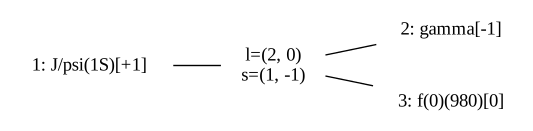
- formulate_wigner_d(transition: StateTransition, node_id: int) Expr[source]#
Compute
WignerDfor a transition node.Following [7], Eq. (4.16), but taking the complex conjugate by flipping the sign of the azimuthal angle \(\phi\) (see relation between Wigner-\(D\) and Wigner-\(d\) in Eq. (A.1)).
For a two-body decay \(1 \to 2, 3\), this gives us:
(2)#\[D^{s_1}_{m_1,\lambda_2-\lambda_3}(-\phi,\theta,0)\]with:
\(s_1\) the
Spin.magnitudeof the decaying state,\(m_1\) the
spin_projectionof the decaying state,\(\lambda_{2}, \lambda_{3}\) the helicities of the decay products in in the restframe of \(1\) (can be taken to be their intrinsic
spin_projectionwhen following a constistent boosting procedure),and \(\phi\) and \(\theta\) the helicity angles (see also
get_helicity_angle_symbols()).
Note that \(\lambda_2, \lambda_3\) are ordered by their number of children, then by their state ID (see
TwoBodyDecay).See [9], Eq. (30) for an example of Wigner-\(D\) functions in a sequential two-body decay. Note that this source chose \(\Omega=(\phi,\theta,-\phi)\) as argument to the (conjugated) Wigner-\(D\) function, just like the original paper by Jacob & Wick [14], Eq. (24). See p.119-120 and p.199 in [15] for the two conventions, \(\gamma=0\) versus \(\gamma=-\phi\).
Example
>>> import qrules
>>> reaction = qrules.generate_transitions(
...     initial_state=[("J/psi(1S)", [+1])],
...     final_state=[("gamma", [-1]), "f(0)(980)"],
... )
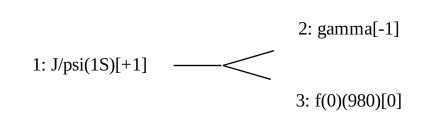
>>> transition = reaction.transitions[0]
>>> formulate_wigner_d(transition, node_id=0)
WignerD(1, 1, -1, -phi_0, theta_0, 0)
- formulate_spin_alignment(transition: StateTransition) PoolSum[source]#
Generate all Wigner-\(D\) combinations for a spin alignment sum.
Generate all Wigner-\(D\) function combinations that appear in [1], Eq.(45), but for a generic multibody decay. Each element in the returned
listis atupleof Wigner-\(D\) functions that appear in the summation, for a specific set of helicities were are summing over. To generate the full sum, make a multiply the Wigner-\(D\) functions in eachtupleand sum over all these products.
- formulate_rotation_chain(transition: StateTransition, rotated_state_id: int) PoolSum[source]#
Formulate the spin alignment sum for a specific chain.
See Eq.(45) from [1]. The chain consists of a series of helicity rotations (see
formulate_helicity_rotation_chain()) plus a Wigner rotation (seeformulate_wigner_rotation()) in case there is more than one helicity rotation.
- formulate_helicity_rotation_chain(transition: StateTransition, rotated_state_id: int, helicity_symbol: Symbol) PoolSum[source]#
Formulate a Wigner-\(D\) for each helicity rotation up some state.
The helicity rotations are performed going through the decay
Topologystarting from the initial state up somerotated_state_id. Each rotation operates on the spin state and is therefore formulated as aWignerDfunction (seeformulate_helicity_rotation()). See {doc}`/usage/helicity/spin-alignment` for more info.
- formulate_wigner_rotation(transition: StateTransition, rotated_state_id: int, helicity_symbol: Symbol, m_prime: Symbol) PoolSum[source]#
Formulate the spin rotation matrices for a Wigner rotation.
A Wigner rotation is the ‘average’ rotation that results form a chain of Lorentz boosts to a new reference frame with regard to a direct boost. See [1], p.6, especially Eq.(36).
- Parameters
transition – The
StateTransitionin which you want to rotate one of the spin states.rotated_state_id – The state ID of a spin
Statethat you want to rotate.helicity_symbol – Optional
Symbolfor \(m\) in \(D^s_{mm'}. Falls back to the value of \) embedded in the providedtransition.m_prime – The summation symbol \(m'\) that should be used when summing over the Wigner-\(D\) functions for this rotation.
- formulate_helicity_rotation(spin_magnitude, spin_projection, m_prime, alpha, beta, gamma, no_zero_spin: bool = False) PoolSum[source]#
Formulate action of an Euler rotation on a spin state.
When rotation a spin state \(\left|s,m\right\rangle\) over Euler angles \(\alpha,\beta,\gamma\), the new state can be expressed in terms of other spin states \(\left|s,m'\right\rangle\) with the help of Wigner-\(D\) expansion coefficients:
(3)#\[R(\alpha,\beta,\gamma)\left|s,m\right\rangle = \sum^s_{m'=-s} D^s_{m',m}\left(\alpha,\beta,\gamma\right) \left|s,m'\right\rangle\]See [1], Eq.(B.5).
This function gives the summation over these Wigner-\(D\) functions and can be used for spin alignment following [1], Eq.(45).
- Parameters
spin_magnitude – Spin magnitude \(s\) of spin state that is being rotated.
spin_projection – Spin projection component \(m\) of the spin state that is being rotated.
m_prime – A index
SymbolorDummythat represents \(m'\) helicities in Eq. (3).alpha – First Euler angle.
beta – Second Euler angle.
gamma – Third Euler angle.
no_zero_spin – Skip value
0.0in the generated spin projection range. Useful for massless particles.
Example
>>> a, b, c, i = sp.symbols("a b c i")
>>> formulate_helicity_rotation(0, 0, i, a, b, c)
PoolSum(WignerD(0, 0, i, a, b, c), (i, (0,)))
>>> formulate_helicity_rotation(1/2, -1/2, i, a, b, c)
PoolSum(WignerD(1/2, -1/2, i, a, b, c), (i, (-1/2, 1/2)))
Submodules and Subpackages