
helicity
helicity
import ampform.helicity
Generate an amplitude model with the helicity formalism.
- class ParameterValues(parameters: Mapping[Symbol, Union[float, complex, int]])[source]
Bases:
MappingOrdered mapping to
ParameterValuewith convenient getter and setter.>>> a, b, c = sp.symbols("a b c") >>> parameters = ParameterValues({a: 0.0, b: 1+1j, c: -2}) >>> parameters[a] 0.0 >>> parameters["b"] (1+1j) >>> parameters["b"] = 3 >>> parameters[1] 3 >>> parameters[2] -2 >>> parameters[2] = 3.14 >>> parameters[c] 3.14
- class HelicityModel(intensity: Expr, amplitudes: Mapping[Indexed, Expr], parameter_defaults: Mapping[Symbol, Union[float, complex, int]], kinematic_variables: Mapping[Symbol, Expr], components: Mapping[str, Expr], reaction_info: ReactionInfo)[source]
Bases:
object- intensity: Expr
Main expression describing the intensity over
kinematic_variables.
- amplitudes: OrderedDict[Indexed, Expr]
Definitions for the amplitudes that appear in
intensity.The main
intensityis a sum over amplitudes for each initial and final state helicity combination. These amplitudes are indicated with assp.Indexedinstances and this attribute provides the definitions for each of these. See also TR-014.
- parameter_defaults: ParameterValues
A mapping of suggested parameter values.
Keys are
Symbolinstances from the mainexpressionthat should be interpreted as parameters (as opposed tokinematic_variables). The symbols are ordered alphabetically by name with natural sort order. Values have been extracted from the inputReactionInfo.
- kinematic_variables: OrderedDict[Symbol, Expr]
Expressions for converting four-momenta to kinematic variables.
- components: OrderedDict[str, Expr]
A mapping for identifying main components in the
expression.Keys are the component names (
str), formatted as LaTeX, and values are sub-expressions in the mainexpression. The mapping is anOrderedDictthat orders the component names alphabetically with natural sort order.
- reaction_info: ReactionInfo
- property expression: Expr
Expression for the
intensitywith all amplitudes fully expressed.Constructed from
intensityby substituting its amplitude symbols with the definitions withamplitudes.
- rename_symbols(renames: Union[Iterable[Tuple[str, str]], Mapping[str, str]]) HelicityModel[source]
Rename certain symbols in the model.
Renames all
Symbolinstance that appear inexpression,parameter_defaults,components, andkinematic_variables. This method can be used to couple parameters.- Parameters
renames – A mapping from old to new names.
- Returns
A new instance of a
HelicityModelwith symbols in all attributes renamed accordingly.
- class DynamicsSelector(transitions: Union[ReactionInfo, Iterable[StateTransition]])[source]
Bases:
MappingConfigure which
ResonanceDynamicsBuilderto use for each node.- assign(selection: Any, builder: ResonanceDynamicsBuilder) None[source]
Assign a
ResonanceDynamicsBuilderto a selection of nodes.Currently, the following types of selections are implements:
str: Select transition nodes by the name of theparentParticle.TwoBodyDecayortupleof aStateTransitionwith a node ID: set dynamics for one specific transition node.
- class HelicityAmplitudeBuilder(reaction: ReactionInfo, stable_final_state_ids: Optional[Iterable[int]] = None, scalar_initial_state_mass: bool = False)[source]
Bases:
objectAmplitude model generator for the helicity formalism.
- Parameters
reaction – The
ReactionInfofrom which toformulate()an amplitude model.stable_final_state_ids – Put final state ‘invariant’ masses (\(m_0, m_1, \dots\)) under
HelicityModel.parameter_defaults(with a scalar suggested value) instead ofkinematic_variables(which are expressions to compute an event-wise array of invariant masses). This is useful if final state particles are stable.stable_final_state_ids –
Put the invariant of the initial state (\(m_{012\dots}\)) under
HelicityModel.parameter_defaults(with a scalar suggested value) instead ofkinematic_variables. This is useful if four-momenta were generated with or kinematically fit to a specific initial state energy.See also
- property adapter: HelicityAdapter
Converter for computing kinematic variables from four-momenta.
- property dynamics_choices: DynamicsSelector
- property stable_final_state_ids: Optional[Set[int]]
IDs of the final states that should be considered stable.
The ‘invariant’ mass symbols for these final states will be inserted as scalar values into the
parameter_defaults.
- property scalar_initial_state_mass: bool
Add initial state mass as scalar value to
parameter_defaults.See also
- set_dynamics(particle_name: str, dynamics_builder: ResonanceDynamicsBuilder) None[source]
- formulate() HelicityModel[source]
- class CanonicalAmplitudeBuilder(reaction_result: ReactionInfo)[source]
Bases:
HelicityAmplitudeBuilderAmplitude model generator for the canonical helicity formalism.
This class defines a full amplitude in the canonical formalism, using the helicity formalism as a foundation. The key here is that we take the full helicity intensity as a template, and just exchange the helicity amplitudes \(F\) as a sum of canonical amplitudes \(A\):
\[F^J_{\lambda_1,\lambda_2} = \sum_{LS} \mathrm{norm}(A^J_{LS})C^2.\]Here, \(C\) stands for Clebsch-Gordan factor.
See also
- formulate_clebsch_gordan_coefficients(transition: StateTransition, node_id: int) Expr[source]
Compute the two Clebsch-Gordan coefficients for a state transition node.
In the canonical basis (also called partial wave basis), Clebsch-Gordan coefficients ensure that the projection of angular momentum is conserved ([3], p. 4). When calling
generate_transitions()withformalism="canonical-helicity", AmpForm formulates the amplitude in the canonical basis from amplitudes in the helicity basis using the transformation in [1], Eq. (4.32). See also [3], Eq. (28).This function produces the two Clebsch-Gordan coefficients in [1], Eq. (4.32). For a two-body decay \(1 \to 2, 3\), we get:
(1)¶\[C^{s_1,\lambda}_{L,0,S,\lambda} C^{S,\lambda}_{s_2,\lambda_2,s_3,-\lambda_3}\]with:
\(s_i\) the intrinsic
Spin.magnitudeof each state \(i\),\(\lambda_{2}, \lambda_{3}\) the helicities of the decay products (can be taken to be their
spin_projectionwhen following a constistent boosting procedure),\(\lambda=\lambda_{2}-\lambda_{3}\),
\(L\) the total angular momentum of the final state pair (
l_magnitude),\(S\) the coupled spin magnitude of the final state pair (
s_magnitude),and \(C^{j_3,m_3}_{j_1,m_1,j_2,m_2} = \langle j1,m1;j2,m2|j3,m3\rangle\), as in Clebsch-Gordan Coefficients.
Example
>>> import qrules
>>> reaction = qrules.generate_transitions(
...     initial_state=[("J/psi(1S)", [+1])],
...     final_state=[("gamma", [-1]), "f(0)(980)"],
... )
>>> transition = reaction.transitions[1]  # angular momentum 2
>>> formulate_clebsch_gordan_coefficients(transition, node_id=0)
CG(1, -1, 0, 0, 1, -1)*CG(2, 0, 1, -1, 1, -1)
\[C^{s_1,\lambda}_{L,0,S,\lambda} C^{S,\lambda}_{s_2,\lambda_2,s_3,-\lambda_3} = C^{1,(-1-0)}_{2,0,1,(-1-0)} C^{1,(-1-0)}_{1,-1,0,0} = C^{1,-1}_{2,0,1,-1} C^{1,-1}_{1,-1,0,0}\]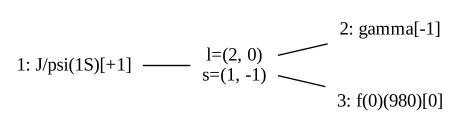
- formulate_wigner_d(transition: StateTransition, node_id: int) Expr[source]
Compute
WignerDfor a transition node.Following [3], Eq. (10). For a two-body decay \(1 \to 2, 3\), we get
(2)¶\[D^{s_1}_{m_1,\lambda_2-\lambda_3}(-\phi,\theta,0)\]with:
\(s_1\) the
Spin.magnitudeof the decaying state,\(m_1\) the
spin_projectionof the decaying state,\(\lambda_{2}, \lambda_{3}\) the helicities of the decay products in in the restframe of \(1\) (can be taken to be their intrinsic
spin_projectionwhen following a constistent boosting procedure),and \(\phi\) and \(\theta\) the helicity angles (see also
get_helicity_angle_label()).
Note that \(\lambda_2, \lambda_3\) are ordered by their number of children, then by their state ID (see
TwoBodyDecay).See [3], Eq. (30) for an example of Wigner-\(D\) functions in a sequential two-body decay.
Example
>>> import qrules
>>> reaction = qrules.generate_transitions(
...     initial_state=[("J/psi(1S)", [+1])],
...     final_state=[("gamma", [-1]), "f(0)(980)"],
... )
>>> transition = reaction.transitions[0]
>>> formulate_wigner_d(transition, node_id=0)
WignerD(1, 1, -1, -phi_0, theta_0, 0)
\[D^{s_1}_{m_1,\lambda_2-\lambda_3}\left(-\phi,\theta,0\right) = D^{1}_{+1,(-1-0)}\left(-\phi_0,\theta_0,0\right) = D^{1}_{1,-1}\left(-\phi_0,\theta_0,0\right)\]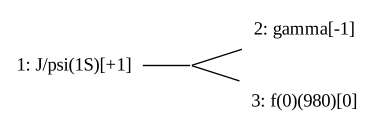
- get_prefactor(transition: StateTransition) float[source]
Calculate the product of all prefactors defined in this transition.
- group_transitions(transitions: Iterable[StateTransition]) List[List[StateTransition]][source]
Match final and initial states in groups.
Each
StateTransitioncorresponds to a specific state transition amplitude. This function groups together transitions, which have the same initial and final state (including spin). This is needed to determine the coherency of the individual amplitude parts.
Submodules and Subpackages